
Blog 1: The Writer’s Notebook? What is it?

Photo by Bich Tran on Pexels.com 
Photo by Bich Tran on Pexels.com 
Photo by rawpixel.com on Pexels.com 
Photo by Alena Koval on Pexels.com
Why a writer’s notebook one might ask, but it’s clear that it’s like a journal of the author’s unique personality. For some it may be a place to write down big ideas or short notes for later referral. For others maybe it’s a place to write an encouraging idea or a short poem that brings meaning to ones life. Then again, maybe it’s a place to write your statistics and a place to store calculations for the mathematician. While for the artist, it is a place to store images that life provides at unusual moments or from deep within a guarded soul a memory for only themselves to see.
To develop a writer’s notebook a lot of time is not required. One only needs to have a special book that carries meaning for themselves and to have it close by to record whatever funny thought, poem, or idea comes to mind. By doing this we collect many special thoughts and ideas that are meaningful to us as individuals which offer ideas for us as writers. Often times, these short clips of our lives are the clique we need to get the writing piece started when we experience a writer’s block.
According to an article I read in School Talk entitled the “Writer’s Notebook: A Place to Dream, Wonder, and Explore“ written by the National Council of Teachers of English, a writer’s notebook is “a place to react.” This is a “safe place” for students, writers, and researcher’s alike with “no grades, no one correcting their grammar (Fletcher, R., Herschlein, L., Gallagher, B., Portalupi, J. (2001), p. 1).” As most of us know writing for school assignments or research is oftentimes not deemed as exciting or writing for fun so this where the writing notebook becomes a very important part of our existence. Since I am a foreign language teacher this would have been an excellent place for me to create my own language, which I did, known as the Spafrajawa for an undergrad class I took. Had I of done a writer’s notebook all of my ideas would have been easily located, but instead it is now is floating somewhere on a prezi and I can’t remember the information to access it.
For some students, these notebooks may not take a lot of time to jot ideas, but for others great thought may be contributed to them or it may be that they just don’t feel like they have anything to write about. The most important factor for doing a writer’s notebook as a class is to remember “to dedicate the precious time it takes to let them do it (Fletcher, R., Herschlein, L., Gallagher, B., Portalupi, J. (2001), p. 2).” The idea is that they write something down. This will become easier the more the students do it. However, just as anything else in life writing, specifically writing well for publishing, is developed through stages.
These stages begin with the writer’s notebook. The specific stages are: “word work, moving to paper, revising/editing, and then the final form (Fletcher, R., Herschlein, L., Gallagher, B., Portalupi, J. (2001), p. 3).” One thing I really enjoyed about this article was an exercise for students to do if they find themselves with writer’s block. it is an exercise called, “Three by Three”. In this exercise you “list three-word phrases for three minutes. Select a single word to designate a subject: summer, beach, school, etc. Get pencils ready—go! It doesn’t matter if the three-word phrases make sense. If you think of two words, and get stuck, put anything onto the paper (Fletcher, R., Herschlein, L., Gallagher, B., Portalupi, J. (2001), p. 4).” I, personally, love a good word play. The point in doing a writer’s notebook is to “write…some little or big thing every day,” not stuff like your daily routine, but stuff like “feelings or emotions (Fletcher, R., Herschlein, L., Gallagher, B., Portalupi, J. (2001), p. 5).” In other words, what made your day unique, really special, or just happened to be out of the ordinary? The special stuff, the meaningful stuff including “sounds, smells”, and other meaningful stuff. Just remember, “A writer’s notebook can be many things: a place to make mistakes, to experiment, to record overheard conversations or family stories, to remember an inspiring quotation, free associate, ask questions, or record beautiful or unusual language, to jot down the seeds of unborn stories or story beginning, to tell the truth, or to lie (Fletcher, R., Herschlein, L., Gallagher, B., Portalupi, J. (2001), p. 5).”
Along with this article I was introduced to my most favorite textbook ever, Textbook, written by Amy Krouse Rosenthal. This was not a normal textbook. I loved the fact that it had an interactive feature, but obviously the text number no longer works. However, I must say that I found this book very enlightening, interactive, and fun all the same. I honestly felt that I could relate to much of what Amy had to say about her own life and what she chose to document in her notebook.
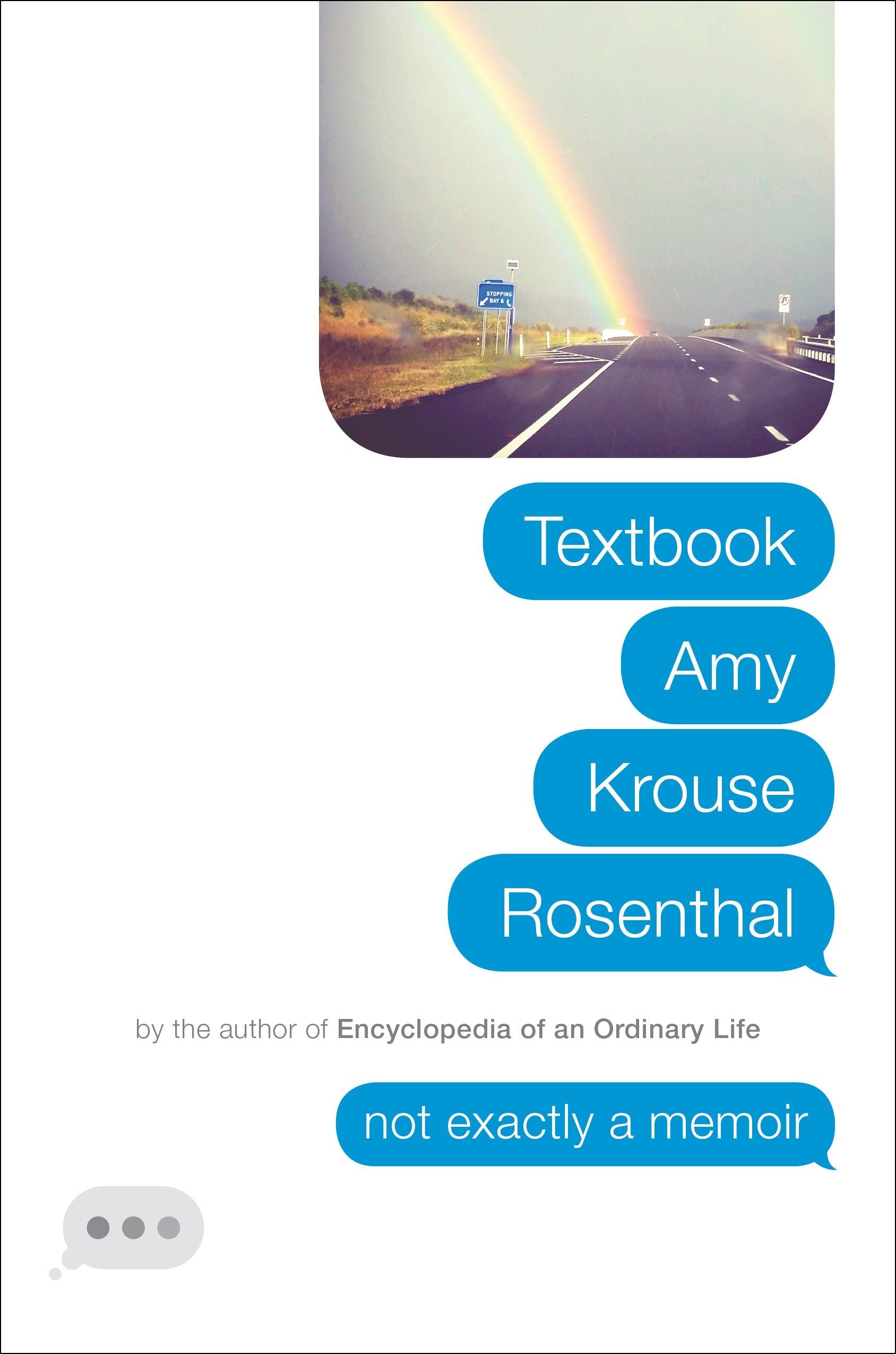
The other aspect was the ease of reading and the brevity in the style she has chosen to use to print this book, an excellent choice in my opinion. There were two quotes that I really liked and added to my own writer’s notebook. One of these was the words of philosopher Wittgnstein which stated, “The aspects of things that are most important for us are hidden because of their simplicity and familiarity. One is unable to notice something because it is always before one’s eyes (Rosenthal, A.K. (2016), p. xv).” I thought about how true this statement is and how most of us fall into this trap as our lives become so busy and we become so comfortable with our situations, but we truly fail to see those who stand right beside of us. The other come from the words of Albert Einstein, “There are only two ways to live your life. One is though nothing is a miracle. The other is as though everything is a miracle (Rosenthal, A.K. (2016), p. 33).” In my opinion, this was just a beautiful view.
Now we get to our question, what is serendipity? You, don’t know either? Well, I must say that makes me feel better. In my journey to discover this meaning I found this book to be hilarious, not to mention that this word is used a lot of places. Therefore, deriving meaning for this word is very important. Even after reading I was not one-hundred percent sure, but I felt that it had to do with stories which are unique to us as individuals. Therefore, my serendipity story would be very different from yours and make me my own very uniquely human being. So afterwards I decided to consult the dictionary for confirmation on the word and found serendipity to mean “the faculty or phenomenon of finding valuable or agreeable things not sought for; also : an instance of this (Merriam-Webster Dictionary).” Now those beautiful and unique words of both the philosopher and the genius make sense. We don’t control what other’s say, we simply are touched by them and derive meaning from them for ourself. We might not have actually went in search of them, we just happened to be present when they were spoken, or to be browsing when we wandered upon them. These are the small things or the big things for the writer’s notebook.
Then we have our Mentor Texts written by Lynne R. Dorfman and Rose Cappelli. I absolutely found this book to be written very plainly and clear. It was an awesome addition to my teacher’s collection. As with anything in life we learn from others by imitation, watching, or doing alongside of others. Such is the case of the information presented within this book. I am looking forward to digging into the information each of these author’s present and discussing in greater detail in future blogs the information that I discover which I am sure to find valuable.

The statement that resonated with me the most within this textbook was the statement by the authors, “We all need mentors in our lives—those knowledgeable others who help us learn how to be teachers, mothers, musicians, artists, athletes—who help us do what we could not do before on our own (Dorfman, L., Cappelli, R. (2017), p. ix).” As for chapter one there were many good points that stood out to me, but the greatest being how to choose a mentor text and what to look for in doing such along while finding a balance which reflects each of the students who will enter your classroom. Then learning how to use the mentor text to achieve these goals. As we are just beginning this journey, I am looking forward to our next blog to talk of this particular part of journey in more depth.
References
Dorfman, L. R., & Cappelli, R. (2017). Mentor texts: Teaching writing through children’s literature, K-6. Second Edition. Portland, Me: Stenhouse.
Fletcher, R., Herschlein, L., Gallagher, B., Portalupi, J. (2001). Writer’s notebook: A place to dream, wonder, and explore. School Talk, 6(4), 1-6.
Rosenthal, A. K. (2016). Textbook Amy Krouse Rosenthal: Not exactly a memoir. New York, NY: Dutton.
serendipity (n.d.). In Merriam-Webster.com. Retrieved from
hacker (n.d.). In Merriam-Webster.com. Retrieved from https://www.merriam-webster.com/dictionary/serendipity
 Teaching The Language Arts